
Human Potential Is Not a Soft Skill
May 2026 Webinar: How To Lead and Thrive in the Future of Work


There was a moment during our recent Future of Work conversation that stayed with me long after the webinar ended.
We asked attendees a simple question:
“What qualities come to mind that make us uniquely human and distinct from AI?”
The chat lit up almost immediately.
Empathy. Curiosity. Connection. Judgment. Creativity. Compassion. Ethics. Presence.
And underneath those responses was something deeper: Not fear. Not resistance. But longing.
A longing to hold onto the parts of ourselves that make work meaningful.
Because while the public conversation around AI often centers on speed, scale, productivity, and disruption, the emotional undercurrent in workplaces right now sounds very different.
People are quietly asking:
Will there still be room for humanity here?
That’s why this conversation mattered.

During the webinar, Stephanie Wagner and Dr. Joanna Hong from Humin reminded us that the future of work is not ultimately a technology conversation.
It is a leadership conversation.
One of the most powerful reframes from the session was this:
“Soft skills are now differentiators.”
Not because technical capability no longer matters. But because as automation expands, deeply human capacities become more valuable — not less.
Empathy. Awareness. Ethical judgment. Relationship repair. Mentorship. Owning outcomes.
These are not “nice-to-have” workplace traits anymore. They are strategic capabilities.
And perhaps even more importantly, they are the things AI cannot authentically replicate.
One attendee shared that what resonated most was:
“The framing of what is important for humans to keep and hold close in the age of AI.”
Another reflected on the relief of realizing:
“We all have similar concerns.”
That comment stayed with me.
Because beneath every organizational AI strategy right now is a very human tension:
How do we embrace innovation without losing ourselves in the process?
How do we create workplaces where efficiency does not replace discernment? Where convenience does not erode connection? Where automation does not quietly weaken our capacity for reflection, ethical thinking, or difficult conversations?
One slide from the session captured this beautifully:
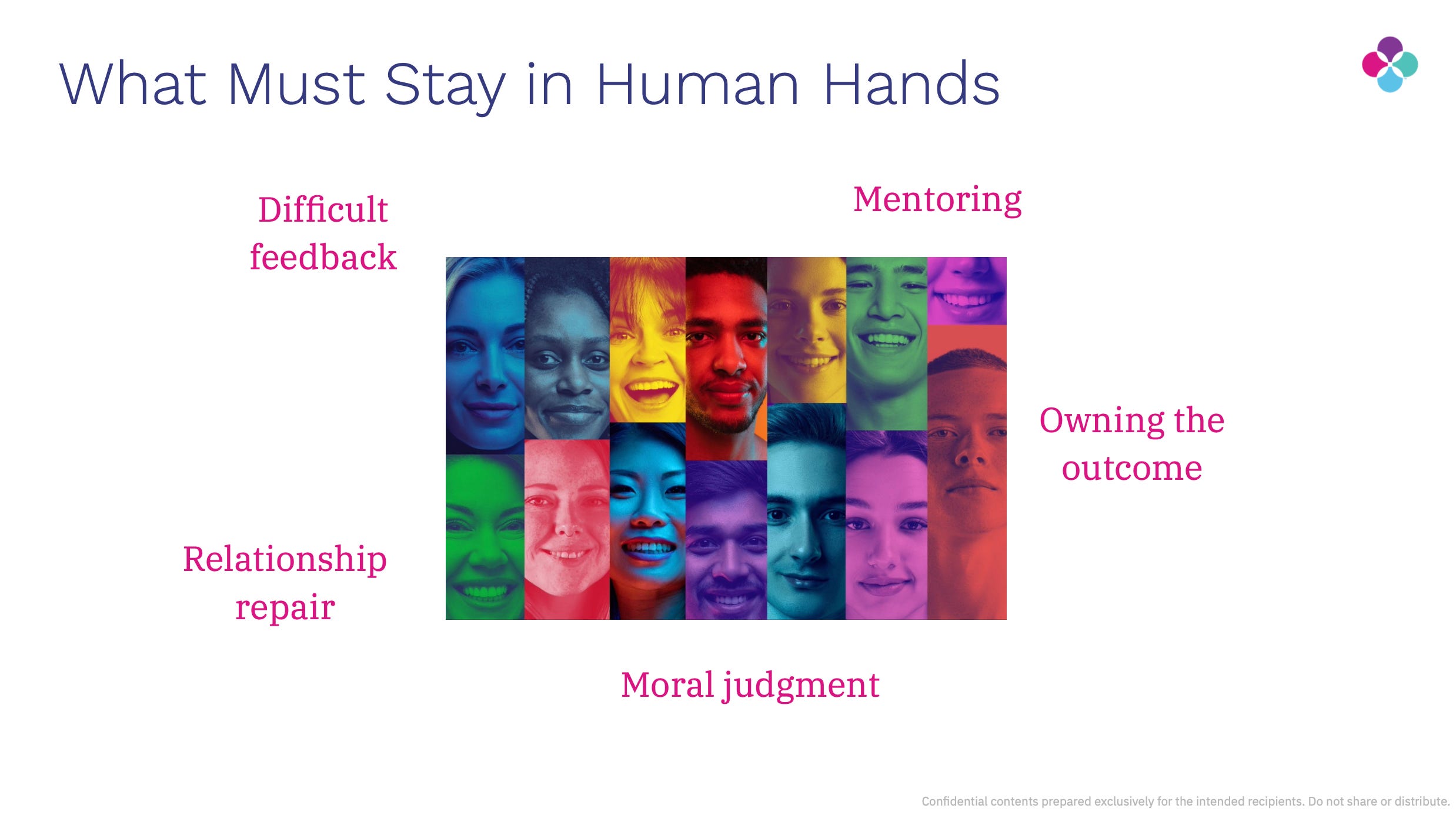
What Must Stay in Human Hands
Difficult feedback
Mentoring
Relationship repair
Moral judgment
Owning the outcome
That list felt less like a framework and more like a warning.
Not because AI is inherently harmful. But because organizations can unintentionally automate away the very moments that build trust, accountability, resilience, and belonging.
The future of work will not be shaped only by what AI can do. It will be shaped by what leaders choose to protect.
And that requires intentionality.
The Humin framework challenged participants to:
Make space for human judgment
Protect the moments AI makes too easy to skip
Train the capacities AI can’t replicate
That third point may be the most important leadership mandate of the next decade.
Not just AI literacy. Human literacy.
The ability to navigate ambiguity. To lead with discernment. To hold complexity. To build trust. To regulate emotion. To create psychological safety. To make ethical decisions when there is no obvious answer.
These capacities are becoming central infrastructure for healthy organizations.
One attendee offered thoughtful feedback that also deserves attention:
They noted that many “future of work” conversations still lean toward conventional organizational assumptions and encouraged broader exploration through systems thinking, organizational design, culture, and alternative workplace models.
I appreciated that perspective because it highlights something important:
The future of work is not a fixed destination. It is an evolving design challenge.
And if we are serious about building more human-centered workplaces, we cannot simply layer AI onto outdated systems and call it transformation.
We have to rethink the systems themselves.
The webinar ended with a question that I think every leader should sit with right now:
“What kind of leader, colleague, and organization do you want to be?”
Because the question is no longer whether AI becomes part of our world. It already is.
The real question is whether we are leading that integration intentionally… or being led by it.
And maybe the future of work is not ultimately about protecting humans from AI.
Maybe it is about protecting humans from becoming less human.
If you missed the session, I highly encourage watching the recording and reflecting on the discussion with your own teams. The conversation was practical, honest, thoughtful, and deeply timely.
Always human in the lead.
Always grounded in practice.
Cheering you on,
~Liza